简单语言交流训练
把任何深的、冷门的、专业的内容,用小学生都能听懂的语言讲清楚。
Contents
怎么用这本手册
这本手册不是用来"读懂"的,是用来每天打开照着练的。
你每天只需要看三块:今天所在 Phase 的 Daily Session Walkthrough、当天要用的 drill、最后记录 3 个指标。其他内容是卡住时再查的:phrase bank 用来替换复杂表达,Troubleshooting 用来处理具体阻力,AI workflow 用来做每周反馈。
Day 1 不要从头读完。直接进入 Phase 1,准备手机录音、纸和计时器,按 60 分钟流程走。你会觉得笨、慢、机械,这正常。这里训练的不是"临场发挥",而是先把临场发挥拆成可重复动作。
Day 30 以后,你看这本手册的方式会变:少看步骤,多看指标。你要问的是:"我的结论是不是 10 秒内出现?我卡住后能不能 5 秒内回到主线?我有没有又开始说 professional-sounding nonsense?"
不要跳过录音。不要跳过第二遍。不要把 scaffold 写成长稿。训练发生在"说出来、听见问题、立刻重说"的循环里。
底层模型 — 唯一的骨架与两块肌肉
训练的真正目标
不是"练简单的语言",是练在开口前把一件事压成最小骨架,让简单语言成为说出这个骨架时的副产品。
人在压力下不会"上升到一个语言美学",只会"掉回到自动化的语言模块"。所以训练目标是把两件事自动化到不占用工作记忆:
- 骨架 — 开口前结构已经在脑子里成型
- 简单词汇 / 短句 — use、maybe、because、people did X 成为压力下的默认反射
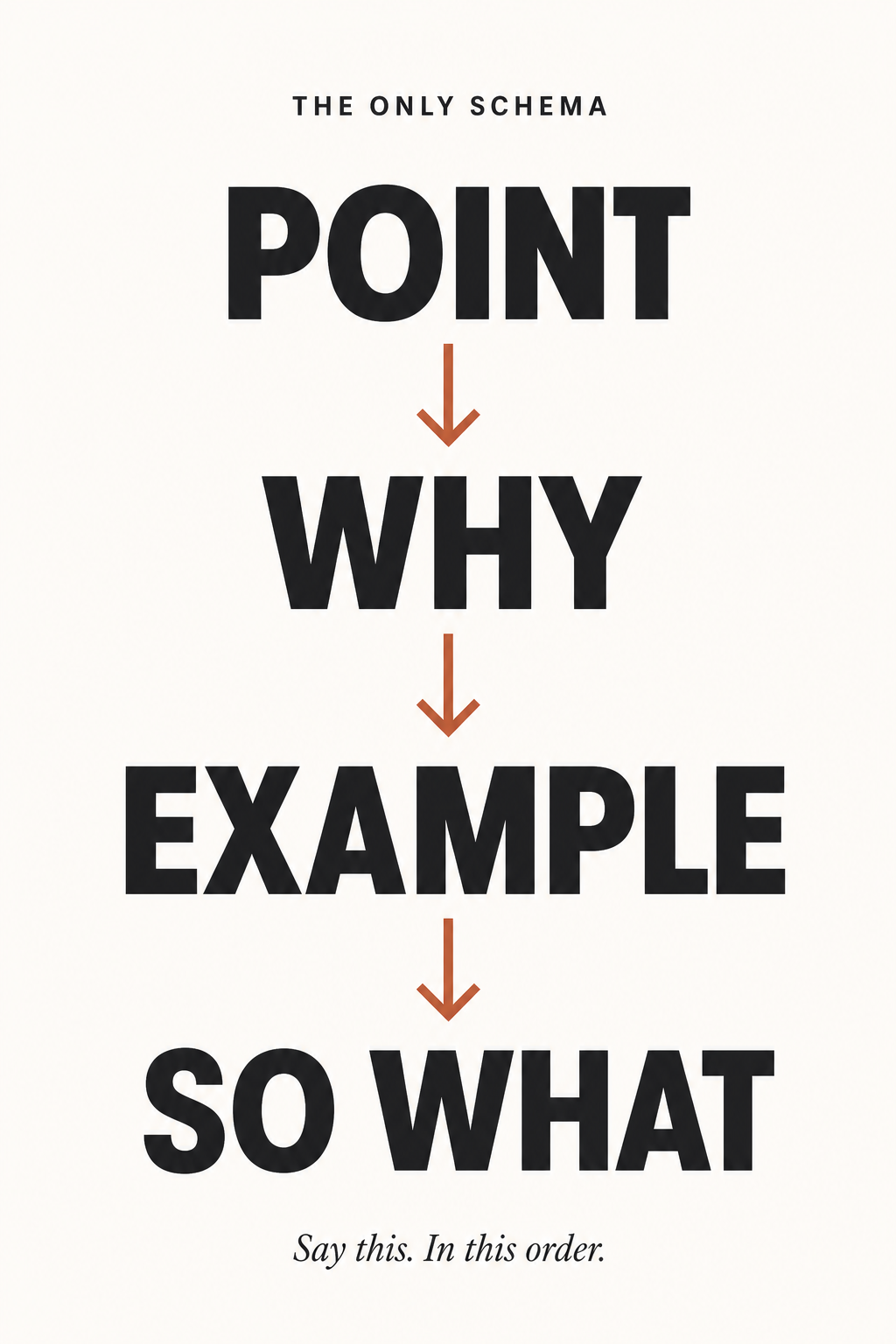
唯一的骨架
每段话永远遵循这一个结构:
结论 → 为什么 → 一个例子 → 所以呢
不学其他任何框架。这一个用到死。
四个锚点 — 一个 worked example
看一个具体例子,把四个锚点对应到一个真实数据科学场景:
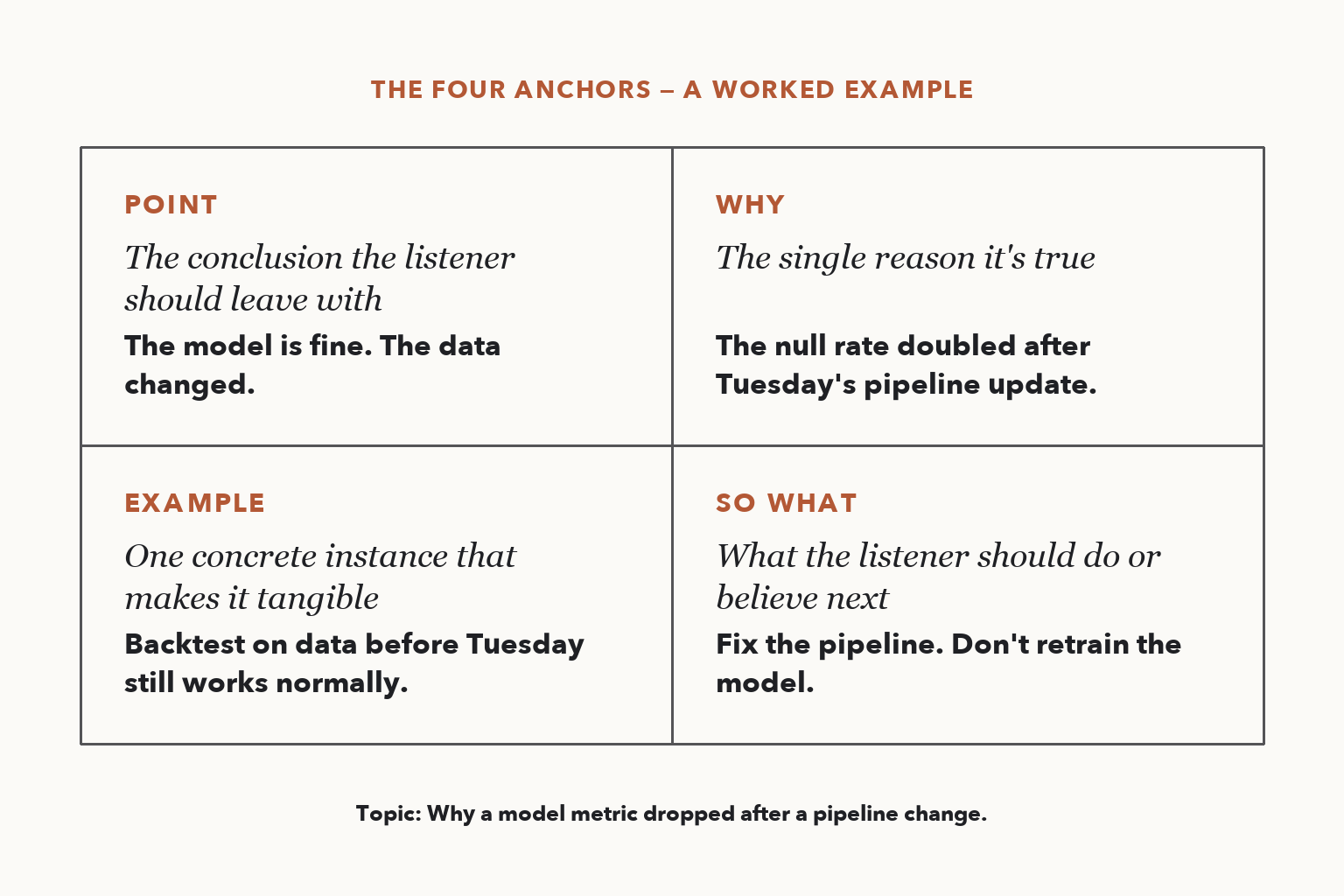
这种对应关系要在你脑子里变成本能:每开口前,先在心里填这四格,再说。
12 周程序总览 + 每周节奏
四个阶段
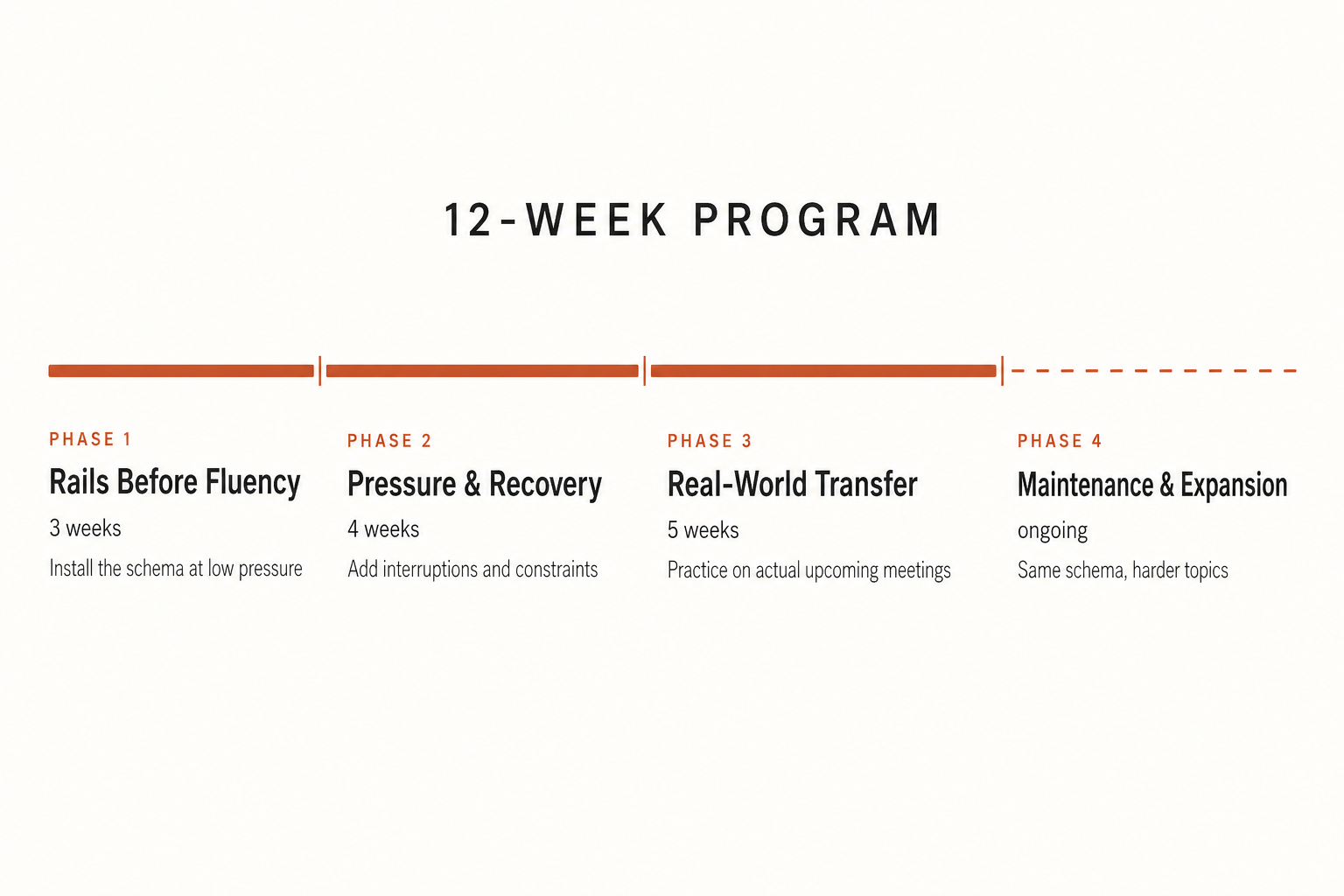
| 阶段 | 时长 | 目标状态 |
|---|---|---|
| Phase 1 — 装轨道 Rails Before Fluency | 3 周 | 2 分钟解释能在前 10 秒说出结论;不大跑题;能识别自己的卡顿点 |
| Phase 2 — 加压力 Pressure & Recovery | 4 周 | 中途被打断、卡顿后能在 5 秒内回到主线 |
| Phase 3 — 真实场景迁移 Real-World Transfer | 5 周 | 能直接用在真实会议、1:1、Slack、跟朋友聊天 |
| Phase 4 — 维持 + 扩展 Maintenance & Expansion | 持续 | 同样的骨架应付更难、更陌生、更即兴的话题 |
每周节奏
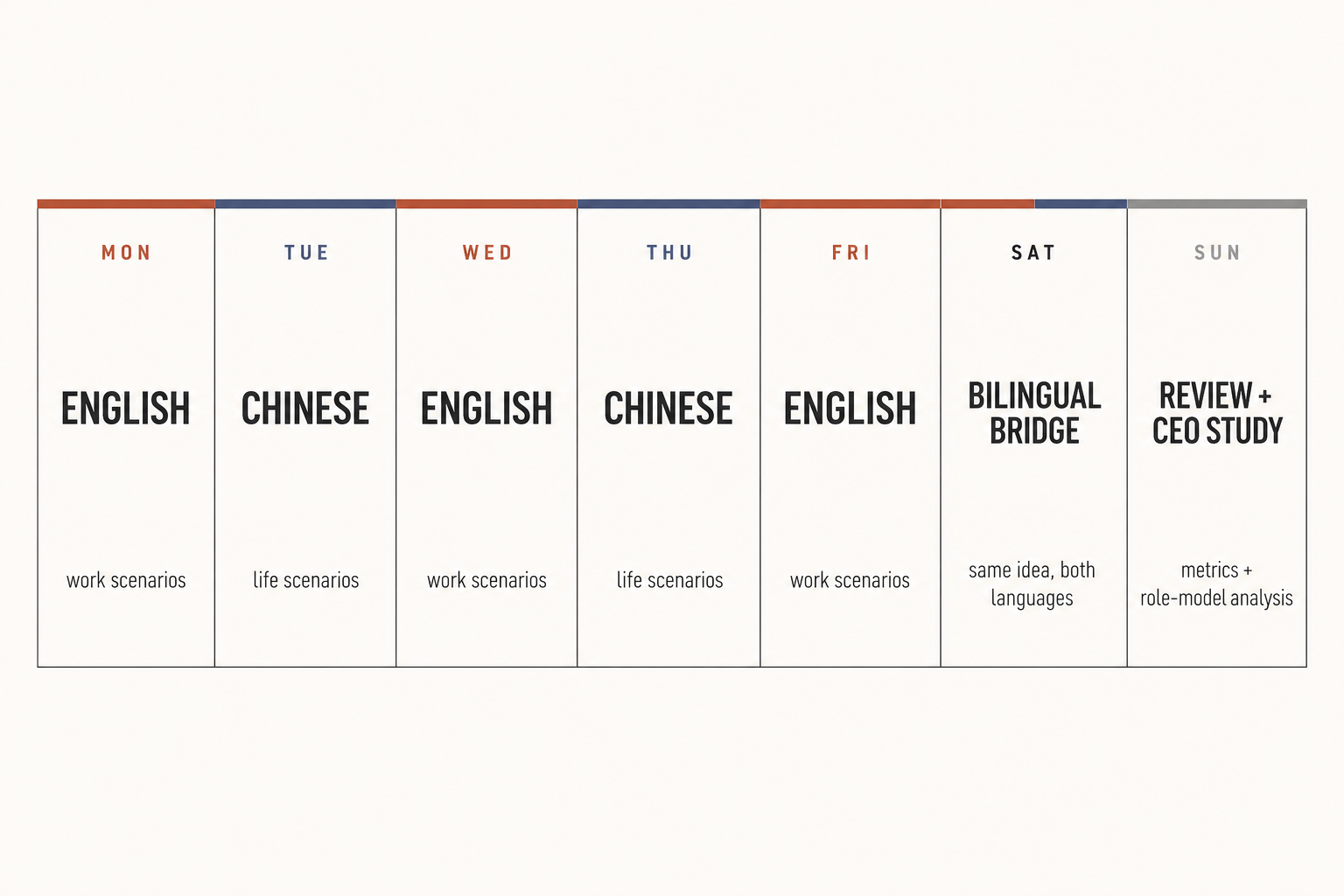
- 周一 / 三 / 五:英文,工作场景素材
- 周二 / 四:中文,生活场景素材
- 周六:双语桥(同一类内容用中、英各讲一遍)
- 周日:复盘 + 学你 CEO 一段发言(15 分钟转录 + 标模式)
英文 reps 多,因为工作 = 高 stake + L2 register inflation 重灾区。中文每周固定两次,是为了确保你不会把这个问题误诊成"只是英语问题"——你在母语里也会绕。
写作的角色
每天有一个 60 秒的纸面 scaffold(4 个 bullet:Point / Why / Example / So what)。这不是写作训练,是开口前的工作记忆卸载。1 分钟硬上限。这种纸面输出存在的唯一目的,是让你嘴上说的时候不需要再现场构造结构。
Phase 1 — Rails Before Fluency(装轨道)
这个阶段是什么
Phase 1 的核心是给你的讲话装轨道。你现在的问题不是脑子里没有内容,而是开口后内容同时涌出来,working memory 被挤爆,于是句子越说越长,结构越来越散。
这一阶段不追求自然,不追求漂亮,也不追求像 CEO。只追求一件事:你能不能在开口前用 60 秒写出四个点,然后按 Point → Why → Example → So what 说完两分钟。
成功的样子很朴素:你一开口就有主句;你知道下一句该说什么;你中间绕了一下,也能回到主线。Phase 1 是力量训练里的基本动作。动作慢一点没关系,但轨道不能丢。
每天 60 分钟
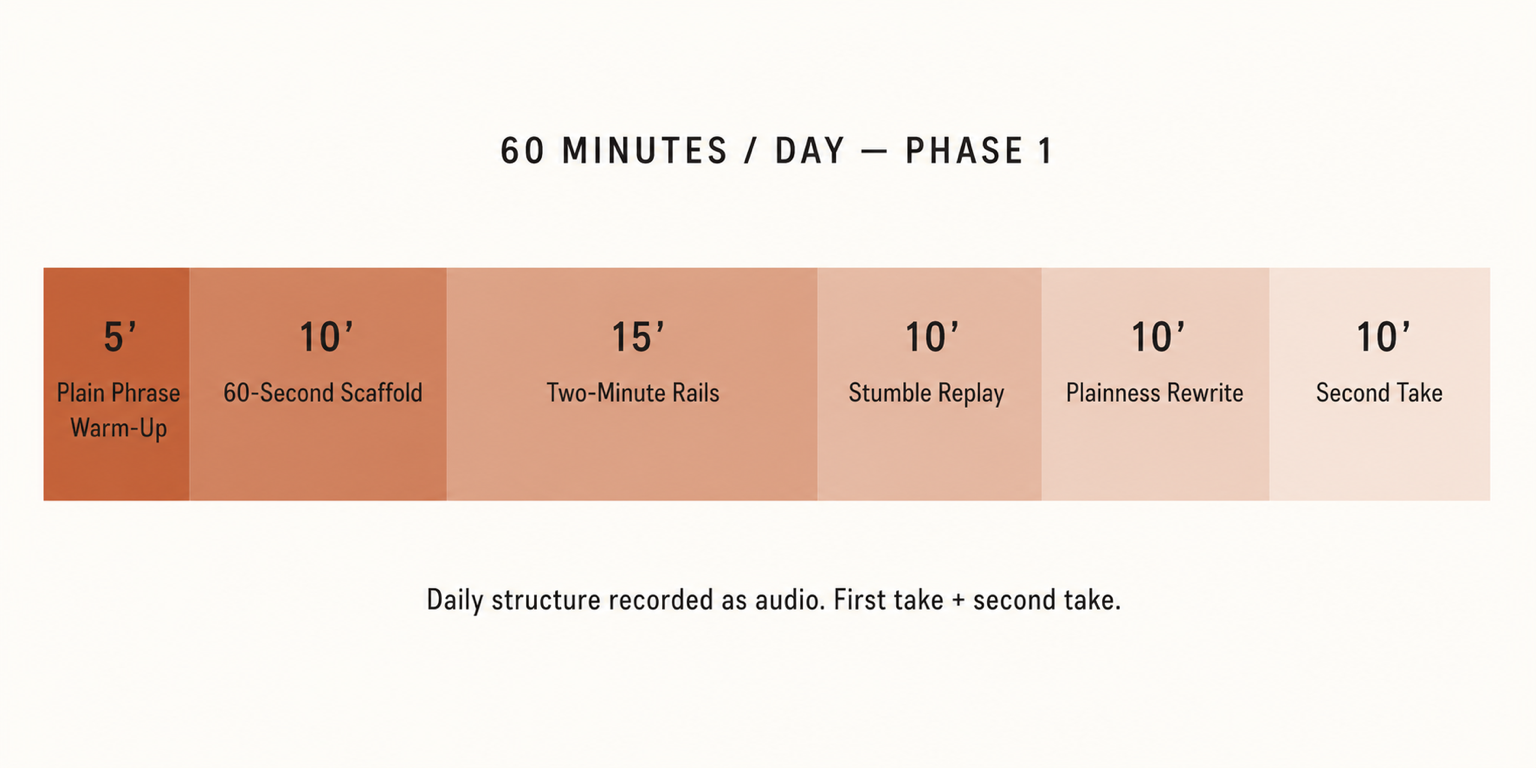
Daily Session Walkthrough
总设置:拿一张纸或打开一个极简 note。不要开大文档。手机打开 Voice Memos。计时器准备 5、10、15 分钟三个常用时长。
今天的例子用 English work topic:
Topic: "Why did the model metric drop after Tuesday's data pipeline change?"
Plain Phrase Warm-Up
先不要讲内容。你要先把嘴巴调到 simple mode。在纸上写 5 个你今天可能会说的 inflated phrases:
| performance degradation | got worse | |
| attributable to | because of | |
| utilize | use | |
| upstream data quality issue | input data problem | |
| there is a possibility that | maybe |
动作:看着第一组,大声说:"performance degradation — got worse." 连说三遍。不要默读。嘴巴要真的走一遍。五组都说完后,再从 plain side 反向说一遍:"got worse, because of, use, input data problem, maybe."
转入下一步时,对自己说:"Now I can talk like a human."
60-Second Scaffold
计时器设 60 秒。只写四行,不许写段落:
例子:
剩下 9 分钟不是让你扩写,而是检查四个点是不是顺。你可以换词,但不能写完整稿。你要让大脑知道:开口前只需要一张小地图,不需要 GPS 全路线。
Two-Minute Rails
打开 Voice Memos,命名为 P1_Day1_Take1_ModelDrop。按录音。吸一口气。第一句必须是:
"My main point is that the model probably did not break. The input data changed."
然后按四段走。示例:
讲完不要立刻评价。停止录音。只写一句:main point appeared at __ seconds。大概估就行。
Stumble Replay
听录音。只找一个卡住点。不要全盘批判。当你听到自己开始绕,比如:
"And another thing is, depending on how we define the feature population…"
暂停。问:我丢的是 Point、Why、Example、还是 So what?
通常你丢的是 Point。于是你补一句 recovery line:
"Let me make the point simpler: the model looks worse because the input changed."
把这句大声说三遍。你训练的是"摔倒后怎么站起来",不是"永远不摔倒"。
Plainness Rewrite for Speech
从录音里挑一句最长、最不像人话的句子。
Before:
"Given the observed shift in feature completeness, it may be premature to attribute the degradation to model quality."
改成 spoken version:
"Some features are now missing. So we should not blame the model yet."
大声说五遍。每次都慢一点。你要让短句进肌肉记忆。
Second Take
重新录。文件名 Take2。这次目标只有三个:
- 第一结论 10 秒内出现
- 少用 inflated phrase
- 卡住时用 recovery line
不要背第一遍。你只看四个 bullet。讲完后记录三个数:time-to-first-conclusion、stumble count、inflated phrase count。
Phase 1 常见陷阱
Cheating on the scaffold
Why: 你怕开口没词,所以写成长稿。
Leads to: 训练变成朗读,不训练 live speech。
Fix: scaffold 只能四行,每行最多 12 个英文词。
第一句铺垫太久
Why: 想先给背景,怕结论显得武断。
Leads to: 听众前 20 秒不知道你要说什么。
Fix: 第一秒就说 "My main point is…"
录第二遍其实在背第一遍
Why: 你想表现得更流畅。
Leads to: 真会议里还是崩,因为你练的是记忆稿。
Fix: 第二遍只看 bullet,不许看 transcript。
只听缺点,不听结构
Why: 听自己声音尴尬,大脑开始攻击语气和口音。
Leads to: 训练变成羞耻体验。
Fix: 每次只找一个结构问题。
把 plain 当成 less precise
Why: PhD 训练让你习惯用高密度词。
Leads to: 又回到 abstract nouns。
Fix: 先 plain,再补 precision。
中间一绕就重录
Why: 你想要干净版本。
Leads to: 没练 recovery。
Fix: 卡住后必须说 "Let me restart…" 再继续。
Phase 1 毕业标准
- 4/5 个 weekday recordings 里,main point 在 12 秒内出现
- 2-minute explanation 能完整走完 Point → Why → Example → So what
- 每次卡住后,能用一句 recovery line 回到主线
- 每次录音 inflated phrase 少于 5 个
- 第二遍比第一遍短至少 15%,但意思不丢
Phase 2 — Pressure & Recovery(加压力)
这个阶段是什么
Phase 2 开始练压力。真实会议不会等你把四个 bullet 舒舒服服讲完。别人会打断,会问 "why",会说 "I'm lost",你自己也会突然发现句子没出口。
这一阶段的重点不是更顺,而是更能恢复。你要训练一个动作:一旦脑子糊住,不继续硬推长句,而是停半拍,用一句短话重新钉住主线。
Phase 1 是铺轨道;Phase 2 是故意在轨道上放小障碍。你会感觉比 Phase 1 更乱,这是设计的一部分。成功不是不卡,而是卡住后不坠落。
每天 60 分钟
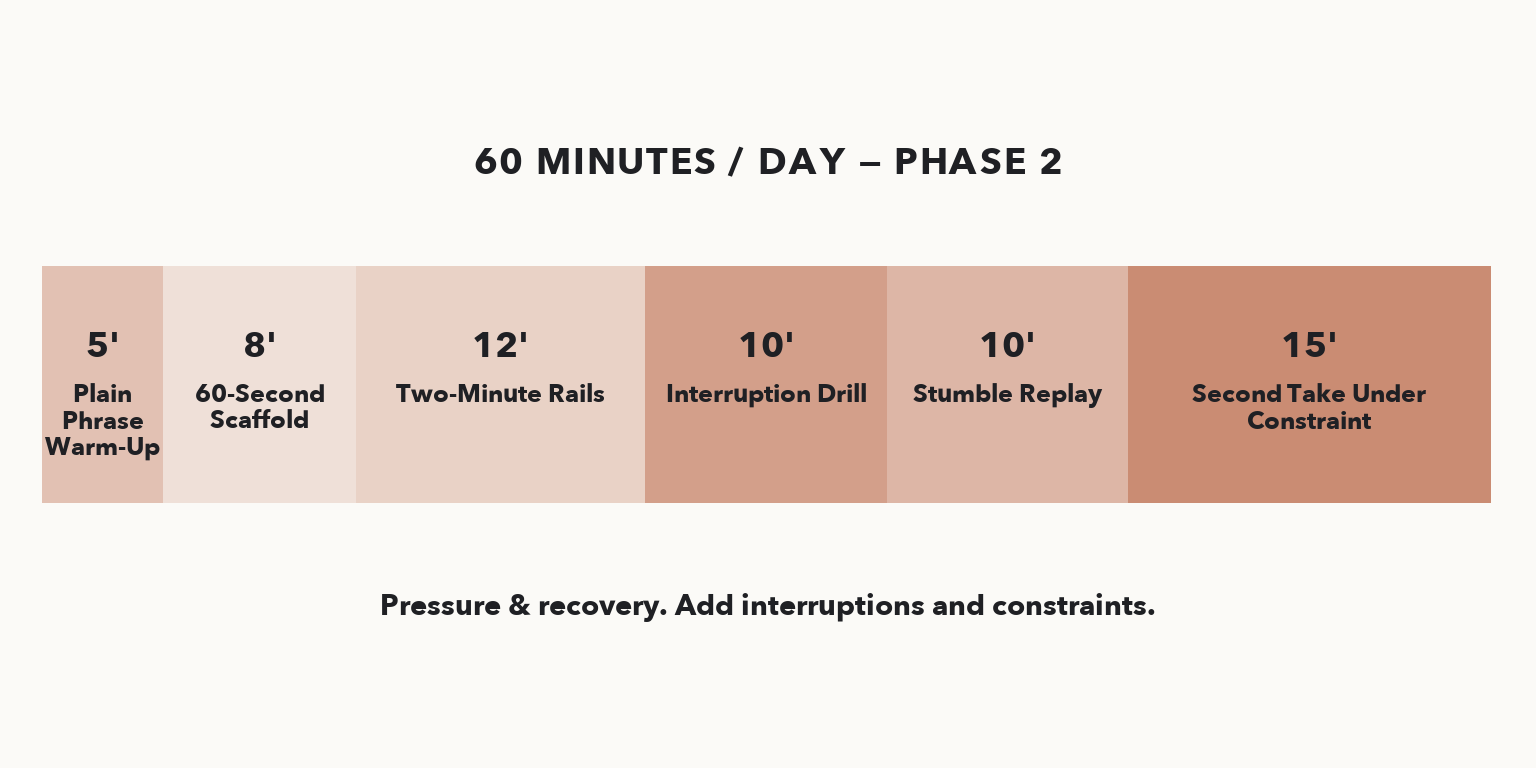
Daily Session Walkthrough
今天用 Chinese life topic:
Topic:「跟朋友解释为什么你最近不想参加临时饭局。」
Plain Phrase Warm-Up
写 5 个中文绕法和短法:
| 我个人觉得可能是因为 | 我觉得是因为 | |
| 其实是这样的,就是说 | 删掉 | |
| 在某种程度上 | 有点 | |
| 这个事情本质上反映的是 | 这件事就是 | |
| 我不是说完全不可以 | 不是不行 |
大声说:"我个人觉得可能是因为 → 我觉得是因为。""其实是这样的,就是说 → 删掉。"
60-Second Scaffold
这阶段 scaffold 变短。计时器 60 秒,只写:
不要写"我也理解大家只是想聚一下"这种防御句。可以说,但不写进 scaffold。
Two-Minute Rails
录音。第一句直接说:"我不是不想见你们,是临时饭局让我很累。"
然后继续:
注意:你不是在演讲。像真的发语音一样说。
Interruption Drill
准备四张 interruption cards,写在纸角:
- "为什么?"
- "我没懂。"
- "所以你到底想怎样?"
- "举个例子。"
重新开始讲。每 30-45 秒随机看一张卡,立刻回答一句,然后回主线。
例如你抽到"所以你到底想怎样?",回答:"我想提前一天约,不要当天临时决定。"
然后接回去:"这样我能安排时间,也不会带着压力去见你们。"
Stumble Replay
听最乱的一段。你可能听到:
"就是我也不是说你们这样不好,就是可能每个人节奏不一样…"
暂停。这个句子在防御,不在说明。
Recovery line:
"我重新说短一点:我需要提前知道安排。"
说三遍。
Second Take Under Constraint
这次加 constraint:每句话不超过 15 个中文字左右。不是严格数,是逼你短。
Second take 示例:
这听起来可能太简单。很好。Phase 2 要把"短到有点不习惯"变成正常。
Phase 2 常见陷阱
被 interruption 带跑
Why: 一被问就开始解释所有背景。
Leads to: 主线消失。
Fix: 每个 interruption 只答一句,然后说"回到主点"。
Recovery line 太长
Why: 你想把前面说乱的都补回来。
Leads to: 第二次卡住。
Fix: recovery line 必须少于 12 个英文词或 15 个中文字。
把压力练成焦虑
Why: 每次都追求完美表现。
Leads to: 开始抗拒录音。
Fix: 今天只评 recovery,不评流畅度。
中文开始讲道理过度
Why: 害怕朋友误解你"不合群"。
Leads to: 说不到点子上。
Fix: 先说需求,再说善意。
英文 interruption 里自动升 register
Why: 一紧张就想显得专业。
Leads to: "attributable to / potentially / in terms of" 回来。
Fix: 被打断后只用 simple verbs:use, change, drop, check, wait。
Second take 变成压缩稿朗读
Why: 你想把每句话都优化。
Leads to: 没有 live retrieval。
Fix: 第二遍只保留四个 bullet 和 constraint。
Phase 2 毕业标准
- 被打断后 5 秒内能回到主线
- "I'm lost / 我没懂" 后能给一句 short version
- 4/5 次 second take 比 first take 更短、更清楚
- 不再因为一次卡顿直接重录
- 英文压力下 plain verbs 明显多于 inflated verbs
Phase 3 — Real-World Transfer(真实场景迁移)
这个阶段是什么
Phase 3 把训练搬进真实生活。你不再主要练"一个题目讲清楚",而是练"明天真的要讲的那件事"。这阶段最重要的问题变成:听众是谁?他们需要带走什么?他们会在哪里误解?
这时 scaffold 从结构工具变成沟通工具。你不只是写 Point/Why/Example/So what,还要写 audience、desired takeaway、likely confusion、first sentence。
成功的样子:你在真实会议里开口更快,第一句更稳,别人问的问题更具体。不是所有人都会立刻懂,但他们至少知道你在说哪件事、想让他们做什么决定。
每天 60 分钟
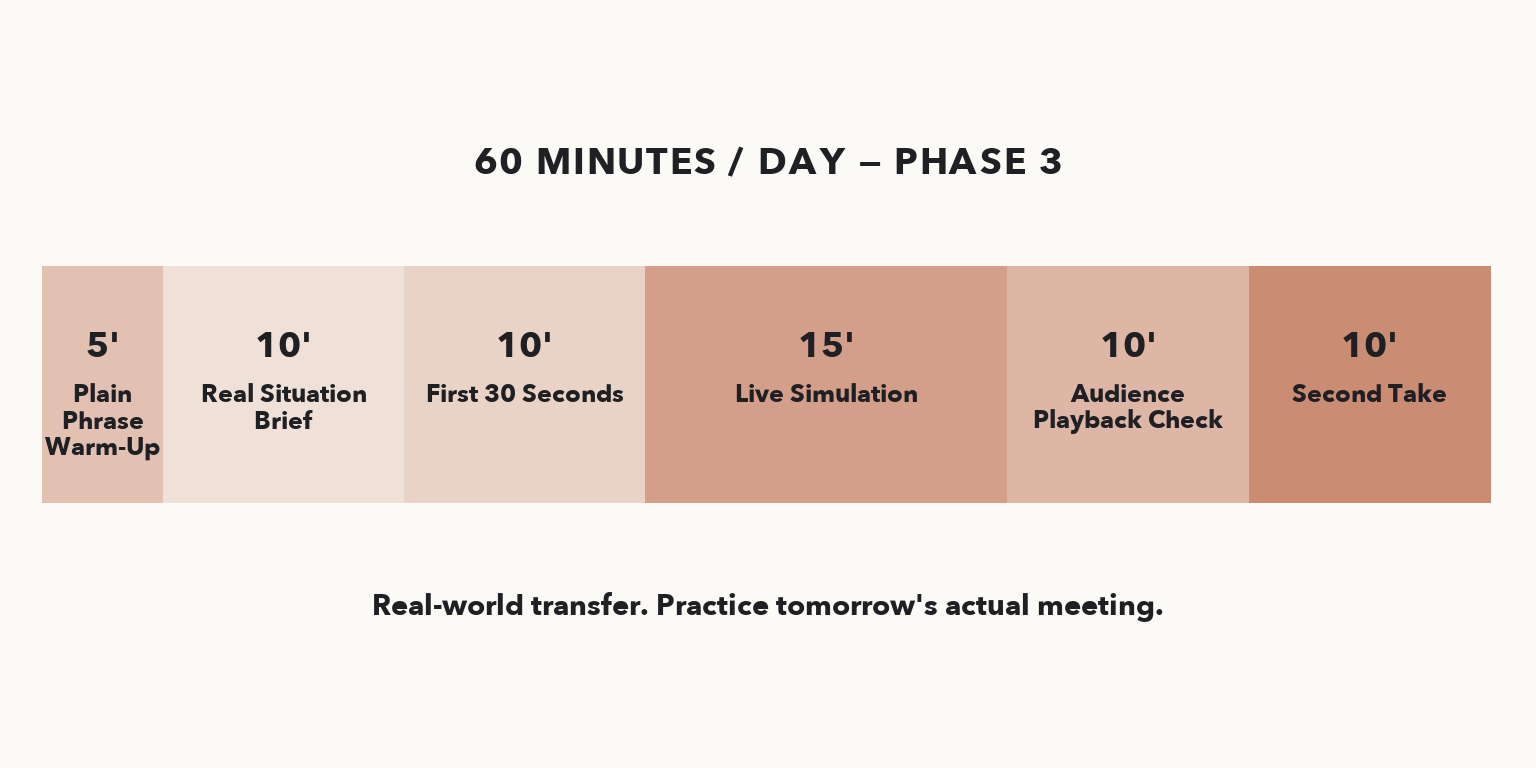
Daily Session Walkthrough
今天用 English work topic:
Real situation: Tomorrow you need to explain to PM + Eng manager why an A/B test should not decide launch yet.
Plain Phrase Warm-Up
写今天高风险词:
| insufficient statistical power | too few users | |
| inconclusive | not clear yet | |
| directional | points that way | |
| make a determination | decide | |
| launch recommendation | what we should do |
大声替换三轮。
Real Situation Brief
写四行:
这一步不要写技术细节。先锁定听众的脑子。
First 30 Seconds
打开录音,但只练开头 30 秒。练 5 次,每次都从同一句开始。
每次练完问:如果我只说这 30 秒,对方知道我的 stance 吗?
Live Simulation
现在模拟真实会议。站起来讲,或者坐在你平时开会的位置。屏幕上只放 brief,不放稿子。
完整说:
然后模拟 PM 问:
"But it's positive, right?"
你回答一句:
"Yes, it points positive, but it is not strong enough to decide by itself."
再回主线。
Audience Playback Check
停止录音。不要先评语法。写:
- What would PM repeat?
- What would Eng repeat?
- What might they still misunderstand?
理想 playback:
- PM: "The test is weak positive, not a launch proof."
- Eng: "Launch is okay only with monitoring."
如果 playback 不是你想要的,说明 first sentence 或 so what 不够清楚。
Second Take
再录一遍。目标:让 desired takeaway 更早、更短、更像会议话。
Second take 第一段可能变成:
"My recommendation is simple: don't use this test as the launch proof. It is weak positive, but too small. If other checks pass, launch with monitoring."
这就是 Phase 3 的方向:更像真实工作语言,更少像分析报告。
Phase 3 常见陷阱
把真实会议练成 mini presentation
Why: 一想到工作就想完整汇报。
Leads to: 会议里没人等你铺完。
Fix: 先练 first 30 seconds,再练完整解释。
忘记 audience
Why: DS instinct 是先讲方法。
Leads to: PM 听不到 decision,Eng 听不到 risk。
Fix: brief 第一行永远写 audience。
Desired takeaway 太模糊
Why: 怕说太满。
Leads to: 听众不知道下一步。
Fix: takeaway 必须包含动作:launch, wait, check, monitor, decide。
技术准确性压倒沟通
Why: 你想把 caveat 都讲完。
Leads to: 主结论被 caveat 淹没。
Fix: 先 conclusion,再 caveat。
AI 改写后太 corporate
Why: AI 默认写得顺滑正式。
Leads to: 你学回 register inflation。
Fix: prompt 里要求 "plain spoken English, not polished business language"。
真实场景太难导致逃回假题目
Why: 真会议有 stakes。
Leads to: transfer 停滞。
Fix: 每周至少 3 天必须用真实 upcoming topic。
Phase 3 毕业标准
- 真实会议前能在 10 分钟内生成 usable brief
- first 30 seconds 能连续说 5 遍,不靠稿
- 同事的问题从"你什么意思?"变成"那我们应该怎么处理 X?"
- playback check 里,听众 takeaway 与目标基本一致
- 你在会议中卡住后能说 "Let me say it simpler" 并继续
Phase 4 — Maintenance & Expansion(维持扩展)
这个阶段是什么
Phase 4 不是"毕业后随便练"。它是长期保持和扩展。前面你练的是稳定动作;现在你要增加题材、场景和速度,同时防止旧习惯回来。
这一阶段会更像真实生活:有时是工作会前 20 分钟,有时是和朋友发语音前,有时是周日复盘 CEO 片段。你仍然每天 1 小时,但 scaffold 更轻,pressure 更自然。
成功的样子:你不需要完整流程也能自动先找 point;你讲话前会本能地问"对方要带走什么?";你听到自己开始绕,会主动收回来。
每天 60 分钟
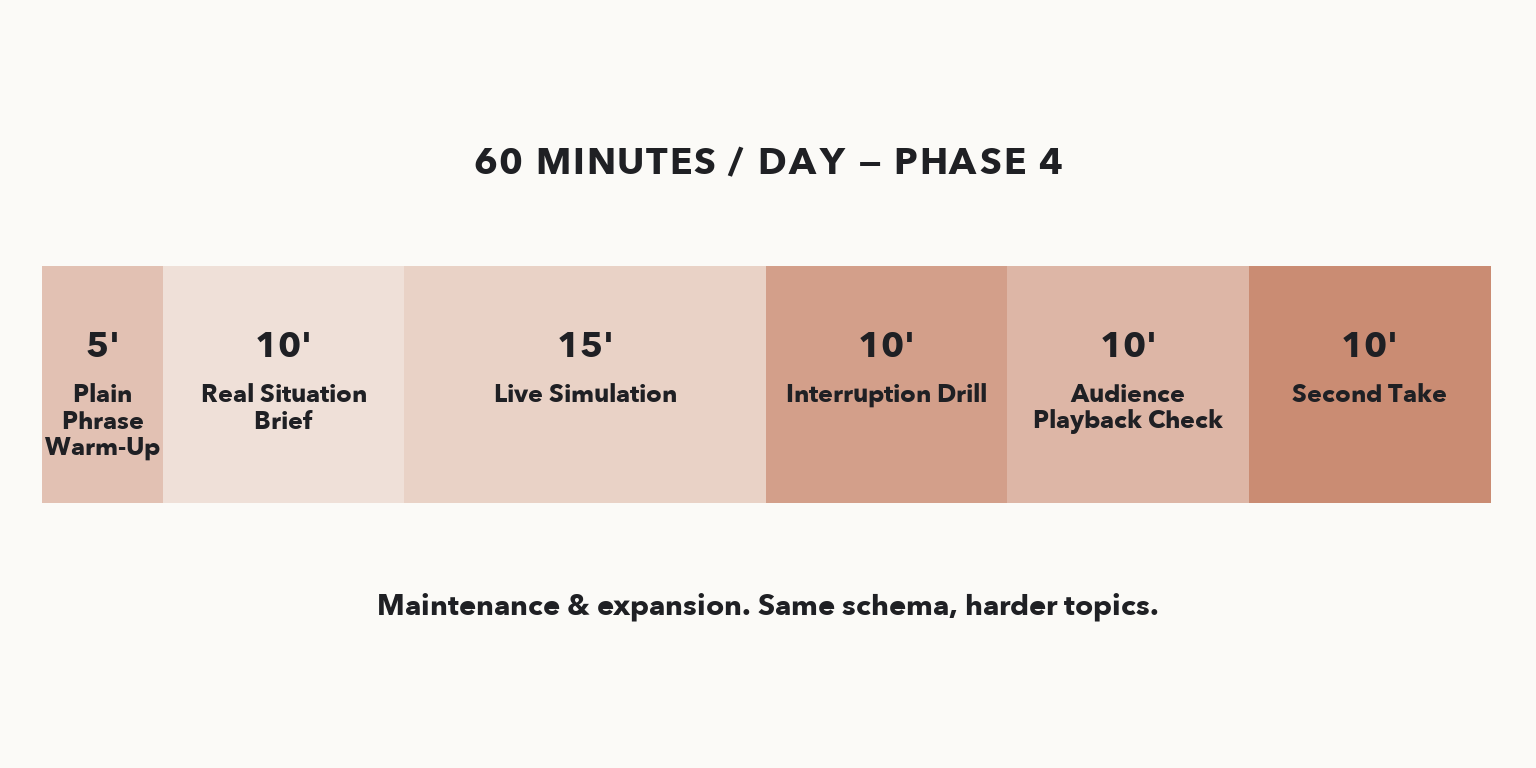
Daily Session Walkthrough
今天用 Chinese life topic:
Topic:「跟伴侣解释为什么你最近聊天时容易不耐烦,但不是因为对方做错了。」
Plain Phrase Warm-Up
写今天可能绕开的表达:
| 我不是针对你这个人 | 我不是怪你 | |
| 最近整体状态比较复杂 | 我最近很累 | |
| 沟通上可能有一些错位 | 我们有时没接上 | |
| 我需要一点空间来调整 | 我想安静一会儿 | |
| 并不是说你做错了什么 | 不是你做错了 |
大声读短法。让身体适应直接但不攻击的语言。
Real Situation Brief
写:
Live Simulation
录音。用真实语气,不要像汇报。
这里的 simple 不等于冷。短句反而减少误伤。
Interruption Drill
抽卡:
- "你是不是嫌我烦?"
- "那我以后都别找你?"
- "你为什么不早说?"
- "所以你想怎样?"
抽到"你是不是嫌我烦?",回答:"不是。我是累,不是嫌你烦。"
然后回主线:"所以我想提前告诉你,我晚上需要安静一点。"
Audience Playback Check
写对方理想复述:
"你不是怪我,你是最近累。晚上不要临时聊复杂安排。"
如果对方可能复述成:"你不想跟我说话。"
那你的 safety sentence 不够早,重练 first sentence。
Second Take
这次 constraint:更温和,但不变长。
Second take:
结束时记录今日三个数:main point 几秒出现 / 卡顿恢复几秒 / inflated phrase 数。
Phase 4 常见陷阱
以为维护期可以不录音
Why: 觉得自己已经会了。
Leads to: 旧习惯悄悄回来。
Fix: 每周至少 4 天录 first take + second take。
题材太舒服
Why: 你会自然选容易讲的事。
Leads to: 技能不扩展。
Fix: 每周至少一个 hard technical topic,一个 hard emotional topic。
越练越像模板
Why: schema 太显性。
Leads to: 听起来机械。
Fix: 保留结构,换自然开头;不要每次都说 "my main point"。
只在练习时清楚,真实场景忘记
Why: real cue 没建立。
Leads to: transfer 断裂。
Fix: 会前或聊天前写一句 first sentence。
过度压缩导致没温度
Why: 把短句误解成冷句。
Leads to: 中文生活场景里容易伤人。
Fix: 短句 + safety sentence:"不是怪你 / I'm not blaming you."
指标疲劳
Why: 每天记录太多。
Leads to: 放弃 tracking。
Fix: 只保留 3 个数。
Phase 4 维持标准(不再叫毕业,是日常状态)
- 不看手册也能自然先找 desired takeaway
- 一周 5 次练习中,4 次 main point 在 10 秒内出现
- hard topic 也能用普通词讲 2 分钟
- 真实沟通后,对方复述的重点基本正确
- register inflation 出现时,你能当场改口:"Let me say that simpler."
Inflated → Plain Phrase Bank
这部分是替换字典。每周打开一两次,挑你这周用过的绕法,强化短法。不用一次背完。
English Work-Context Swaps
Verbs
| utilize | use | Default swap |
| leverage | use | Unless financial leverage |
| implement | do / build / add | Pick concrete action |
| facilitate | help | |
| initiate | start | |
| terminate | stop / end | |
| demonstrate | show | |
| indicate | show / suggest | "suggest" if uncertain |
| obtain | get | |
| conduct | run / do | run an analysis/test |
| perform | do / run | |
| investigate | look into | |
| validate | check | Use validate only if formal |
| determine | decide / find out | |
| communicate | tell / share |
Hedges
| there is a possibility that | maybe | |
| it is possible that | maybe | |
| potentially | maybe / could | |
| may be attributable to | may be because of | |
| it appears that | it looks like | |
| it is likely that | probably | |
| it is unlikely that | probably not | |
| we cannot rule out | it might still be | Use for real uncertainty |
| there is some evidence to suggest | we see some signs | |
| directional but not conclusive | points that way, but not enough |
Abstractions / Nominalizations
| the implementation of X | doing X / adding X | |
| the optimization of X | improving X | |
| the degradation of X | X got worse | |
| the improvement of X | X got better | |
| user engagement deterioration | users clicked less / came back less | Make it observable |
| metric movement | the number changed | |
| data quality issue | data problem | |
| decision-making process | how we decide | |
| model performance | how well the model works | |
| feature availability | whether the feature is present | |
| conversion behavior | whether users convert | |
| retention pattern | whether users come back |
Connectors
| in order to | to | |
| given the fact that | because | |
| due to the fact that | because | |
| as a result of | because of / so | |
| with respect to | about | |
| in terms of | for / about | Often deletable |
| regarding | about | |
| prior to | before | |
| subsequent to | after | |
| at this point in time | now | |
| in the event that | if | |
| despite the fact that | although / but |
Hype / Throat-Clearing
| it's important to note that | delete | Just say the point |
| I just want to highlight that | delete | |
| at the end of the day | delete | |
| broadly speaking | usually delete | |
| to be honest | delete | |
| as mentioned earlier | delete / earlier I said | |
| the key takeaway here is | the point is | |
| from my perspective | I think | |
| I would argue that | I think | |
| needless to say | delete |
DS-Specific Traps
| performance degradation | got worse | |
| statistically significant at p<0.05 | likely real, not noise | Add p-value if needed |
| insufficient statistical power | too few users | |
| confidence interval is wide | the range is still wide | |
| treatment effect | lift / change from the test | Depends on audience |
| heterogeneous treatment effect | it works differently for different groups | |
| feature leakage | the model saw information it should not have | |
| label leakage | the answer leaked into training | |
| distribution shift | the data changed | |
| covariate shift | the input mix changed | |
| calibration issue | the scores don't match real risk | |
| false positive | false alarm | |
| false negative | missed case | |
| precision | when we flag something, how often we're right | For non-DS |
| recall | how many real cases we catch | |
| baseline | what we compare against | |
| counterfactual | what would have happened otherwise | |
| causal inference | figuring out what caused what | |
| observational data | data where we didn't run a test | |
| metric migration | changing how we count the number |
Chinese Conversational Verbosity → Plain
开场铺垫
| 其实是这样的,就是说 | 删掉 | 直接说事 |
| 我个人觉得有可能是因为 | 我觉得是因为 | |
| 就像我之前说的那样 | 删掉 | 除非真要引用 |
| 我想表达的意思就是说 | 我的意思是 | |
| 怎么说呢 | 停顿,不说 | |
| 这个事情吧 | 这件事 |
抽象化
| 这个事情本质上反映的是 | 这件事就是 | |
| 在某种程度上来说 | 有点 | |
| 从更深层次看 | 说白了 | 慎用 |
| 这背后有一个逻辑 | 原因是 | |
| 它呈现出来的问题是 | 问题是 | |
| 核心矛盾在于 | 主要问题是 |
防御和软化过度
| 我不是说完全不可以 | 不是不行 | |
| 我也不是针对你 | 我不是怪你 | 更自然 |
| 你不要误会我的意思 | 我先说清楚 | |
| 我没有任何别的意思 | 我没有别的意思 | |
| 可能是我自己的问题 | 我这边的情况是 | 不要自我贬低 |
| 如果你觉得不方便也没关系 | 不方便也可以 |
时间和因果
| 在当前这个时间节点 | 现在 | |
| 基于这样一个情况 | 因为这样 | |
| 在这种前提之下 | 这样的话 | |
| 由于各种各样的原因 | 因为几个原因 | |
| 最后导致的结果就是 | 所以 | |
| 从而使得 | 所以 |
口头填充
| 然后的话 | 然后 / 删掉 | |
| 就是说 | 删掉 | |
| 对吧 | 删掉 | 除非真问对方 |
| 你懂我意思吧 | 删掉 / 我说清楚了吗 | |
| 反正就是 | 简单说 | |
| 大概就是这样一个情况 | 就是这样 |
录音 & AI 反馈工作流
推荐设置
最简单推荐:iPhone Voice Memos + Mac/AI transcription。
- 录音:iPhone Voice Memos。优点是快、稳定、阻力低
- 命名:
P1_Mon_Take1_ModelDrop,P1_Mon_Take2_ModelDrop - 转写:每周选 2-3 条,不需要每天全转写
- 工具选择:
- Mac built-in dictation 粗转写,适合短段
- Whisper / MacWhisper / whisper.cpp 转 2-minute audio,通常几分钟内完成
- 也可以把音频上传给支持音频转写的 AI 工具
每日录音步骤
- 打开 Voice Memos
- 先录 Take1,不要试讲三遍才录
- 停止后立刻记录:main point 大概几秒出现
- 做 Stumble Replay 或 Audience Playback Check
- 录 Take2
- 只保存必要文件。每周清理一次
转写步骤
- 周日选两条:一条最差,一条最好
- 导出 audio
- 用 Whisper/MacWhisper/AI 转 transcript
- 不修语法,不美化。保留口语错误,因为错误就是数据
- 把 transcript 放进 AI prompt
AI Prompts
Prompt 1 — 找 main point 和冗余
Here is a transcript of my spoken explanation.

Your job:
1. Identify the exact sentence where my main point first appears.
2. Estimate how many seconds/lines before the main point appears.
3. List 3 places where I ramble or add unnecessary setup.
4. Suggest a shorter first sentence.

Do not rewrite the whole speech. Do not make it sound corporate. Use plain spoken English.

Transcript:
[PASTE]
Prompt 2 — 找 inflated phrases
Analyze this spoken transcript for L2 register inflation.

Find phrases that sound overly formal, abstract, or corporate.
For each one, give:
- original phrase
- plain spoken replacement
- why the original adds cognitive load

Focus on words like utilize, leverage, attributable, in order to, potentially,
implementation, degradation, significant.

Transcript:
[PASTE]
Prompt 3 — 改写 first 30 seconds
Rewrite only the first 30 seconds of this explanation.

Constraints:
- conclusion in the first sentence
- plain spoken English
- short sentences
- no corporate polish
- keep the technical meaning accurate
- do not remove necessary uncertainty

Give me two versions:
1. very plain
2. plain but suitable for a work meeting

Transcript:
[PASTE]
Prompt 4 — 中文简化
下面是我一段中文口头表达的转写。

请做四件事:
1. 找出我真正的主点第一次出现在哪里。
2. 标出绕、铺垫、防御、抽象的句子。
3. 把前 30 秒改成更短、更像真人说话的中文。
4. 保留语气的温和,不要改成冷冰冰的命令。

不要写成演讲稿。要像我真的会对朋友/家人说的话。

转写:
[粘贴]
最少必须记录的 3 个数
用 spreadsheet、Notion、纸本都可以。
| Date | Topic | To-1st-conclusion | Recovery time | Inflated count |
|---|---|---|---|---|
| (每天一行) | ||||
如果只能记 3 个数,就记:
- main point 几秒出现
- 卡住后几秒恢复
- inflated phrase 数量
不要记录 20 个指标。指标太多会让训练变成行政工作。
CEO Study — 周日学徒程序
怎么找 CEO 的可用录音
优先找你公司内部真实语境:
- all-hands recordings
- town hall Q&A
- product review opening remarks
- strategy update
- internal podcast / fireside chat
- public podcast interview
- conference talk
- earnings call clips, if relevant
你要找的不是最正式的 keynote,而是 CEO 即兴解释复杂问题的片段。尤其找 Q&A,因为那里最能看到他如何现场组织答案。
15 分钟周日 workflow
每周日只做 15 分钟,不要变成崇拜式研究。
1. 选 60-90 秒片段 — 3 min
标准:
- 他在解释一个复杂问题
- 听众不是同专业专家
- 他不是照稿读
- 你听完能复述 main point
2. 转写 — 3 min
用 AI 或手动粗转写。不要追求完美标点。
3. 标 3 个模式 — 6 min
只标三类:
句长 — 看他是否多用短句。比如:
"The problem is simple. We grew faster than our systems. Now we need to rebuild the systems."
开头第一句 — 他是不是先给 conclusion?
"This is not a demand problem. This is an execution problem."
过渡词 — 他怎么从 point 到 reason?
常见模式:
- "The reason is…"
- "Here's the simple way to think about it…"
- "For example…"
- "So what we're going to do is…"
4. 抄进笔记本 — 3 min
CEO pattern of the week:
First sentence: conclusion before background.
Transition: "The simple way to think about it is…"
Sentence length: mostly under 12 words.
My version to try:
"The simple way to think about this test is: it is positive, but too small."
怎么导入自己的发言,而不是模仿
不要抄他的 wording。抽离 pattern。
错误做法:他常说 "Let me be very clear",于是你也到处说。
正确做法:他先排除误解,再给主点。你也练这个 pattern。
比如 CEO 说:
"This is not a strategy problem. This is a focus problem."
你导入到 DS 语境:
"This is not a model problem. This is a data problem."
中文生活语境:
"这不是我不想见你们。是我需要提前安排。"
你学的是 cognitive move:先切掉错误解释,再给正确解释。
如果找不到 CEO 录音,替代品
选说话风格清楚、短句、低 jargon 的人。不要选演讲华丽的人。
- Patrick Collison:常把复杂商业/技术问题讲得很直
- Jensen Huang 的部分访谈:常用具体比喻解释技术趋势
- Jeff Bezos 早期访谈/股东信口头解释:结构清楚,概念压缩强
- Warren Buffett:复杂金融讲成普通话
- Richard Feynman 访谈:技术解释的 plain-language 经典
- Andrew Ng 面向非专家的 AI 解释:适合技术转普通语言
- 中文可选:罗永浩某些产品解释片段,优点是口语清楚;缺点是风格较强,不要模仿腔调。也可以找讲商业问题很清楚的播客嘉宾,重点看结构,不看人设
替代品标准只有三个:
- 第一结论早出现
- 句子短
- 复杂内容被拆成普通人能跟的台阶
Troubleshooting Q&A
我不知道每天选什么话题
不要每天临时想。周日一次性列 6 个:3 个 English work,2 个 Chinese life,1 个 bilingual bridge。English work 从真实材料里拿:明天的 meeting、最近的 analysis、一个 Slack 争论、一个 dashboard 异常、一个实验结论。Chinese life 从最近 72 小时拿:一次没说清楚的聊天、一个你想拒绝的安排、一个你想解释的情绪、一个朋友问你的建议。题目不需要宏大。越真实越好。标准是:如果你明天可能真的会说这件事,它就是好题目。
我录音的时候听自己声音很尴尬
尴尬不是问题,逃避听才是问题。你不需要"欣赏"自己的声音,你是在做诊断。听录音时只听三个东西:主点几秒出现、哪里开始绕、有没有 inflated phrase。不要评价口音、音色、人格魅力。你可以把声音调小,或者只听前 90 秒。前两周最难,之后大脑会把录音当成训练器材,而不是自我审判。规则:每天只找一个问题,不许开批斗会。
我感觉录第二遍只是在背第一遍
这说明你第二遍看了太多内容,或者第一遍写得太像稿子。修法:第二遍前把 transcript 关掉,只留下四个 bullet。然后换一个限制,比如"90 秒内说完"或"不能用 degradation / significant / leverage"。这样你必须重新组织,而不是背诵。第二遍的目标不是说出同样的话,而是说出同样的意思。真实会议里你也不会背稿,你需要的是在限制下重新取回主线。
讲简单了之后我感觉技术内容被讲浅了 / 不准确了
简单不是删除精度,而是先建立主干。你可以用两层说法:第一层给普通人,"the data changed";第二层再补技术,"specifically, the null rate doubled after the schema change." 如果一开始就说第二层,很多人会失去上下文。训练时先强迫自己说第一层,是为了让对方知道你在讲什么。准确性放在第二句、第三句补。简单的反面不是准确,简单的反面是混乱。
我连续几天都感觉没进步
体感不可靠。看指标。你的 time-to-first-conclusion 有没有从 35 秒降到 18 秒?inflated phrase 有没有少?卡住后有没有更快回来?技能学习常常是平台期:里面在重新布线,外面看不出来。连续 3 天没进步时,不要加练;降低难度。选更熟的话题,把目标缩成一个:第一句说清楚。你需要稳定 reps,不需要每天突破。
工作太忙今天没时间练 1 小时
做 12-minute minimum,不要断链。流程:2 分钟 Plain Phrase Warm-Up,2 分钟 scaffold,3 分钟 first take,2 分钟听开头,3 分钟 second take。今天不做完整复盘,但必须录音。这个 minimum 的目的不是提高很多,而是保持 retrieval pathway。第二天恢复 1 小时,不要补偿性练 2 小时。长期训练最怕"今天没完整时间,所以完全不练"。
我同事讲话也没那么简单,是不是我标准太高了
你的目标不是比同事更像母语者,也不是每句话都幼儿园化。你的目标是让别人更快抓住你的 point,并让你自己不在句子里迷路。很多职场英语确实复杂,但复杂不等于有效。你可以保留必要术语,但结构要简单,句子要短。CEO 给你的启发不是"词汇低级",而是"认知负担低"。这比模仿同事的 corporate register 更有价值。
用 "use" 和 "maybe" 听起来像我英语很差
这是一种 L2 status anxiety。母语高阶说话者经常用 use、maybe、show、change、drop、check,因为这些词处理速度快。真正显得不成熟的不是简单词,而是为了显得专业把句子拉长却没有主点。你可以在需要精度时补术语:"Maybe the data changed; technically, this is a distribution shift." 顺序很重要:先简单抓住人,再加专业精度。
我中文练的时候找不到生活素材
找"不舒服但没说清楚"的小场景。比如:不想临时聚餐、不想马上回消息、觉得某个建议没帮到你、想拒绝家里的请求、想解释为什么最近累、想跟朋友说某句话让你不舒服。中文训练不是练演讲,是练"说到点子上"。如果当天没有素材,就复盘最近一次你说完后觉得对方没懂的聊天,把它重说一遍。
我开始觉得这套 schema 用得太机械
机械感通常出现在正确学习阶段。先不要急着变自然。自然是自动化之后的产物,不是训练初期的目标。Phase 3 以后可以换开头,不一定说 "My main point is"。但底层仍然是 Point → Why → Example → So what。像健身一样,动作练熟后看起来不僵,但内部发力顺序还在。你要去掉的是表面口号,不是结构。
我已经第 5 周了但卡顿恢复还是不快
专门加大 Stumble Replay 和 Interruption Drill。很多人练清楚表达,却没练"出错后怎么回来"。接下来一周,每天选一个卡顿点,写 3 条 recovery lines:"Let me say it simpler." / "The short version is…" / "我重新说短一点。" 然后每条说 10 遍。恢复慢不是因为你不会讲,是因为你没有自动化的重启句。
我录的音根本没人听,会不会浪费
不会。录音的第一听众是你自己的大脑。你平时讲话后只记得模糊感受,录音让问题变成可见对象。你不需要每天发给别人。每周选一条 2 分钟发给 AI 或可信的人就够了。每天录音的价值在于 immediate feedback:你以为自己 10 秒讲到重点,实际可能 40 秒。这个落差必须靠录音看见。
我怕简单直接会显得 rude
直接不等于粗鲁。特别在中文生活场景里,你可以用"安全句 + 短主点"。比如:"我不是怪你。我是想把这件事说清楚。" 然后再讲 point。不要用 3 分钟铺垫来证明你是好人;那会让对方更困惑。温和来自语气和意图,清楚来自结构。两者可以同时存在。
我技术话题太复杂,两分钟讲不完
两分钟讲不完完整内容,但可以讲完主线。训练的单位不是 full knowledge transfer,而是 first useful explanation。你要说的是:结论是什么、为什么大概成立、一个例子、下一步怎么做。深水区可以留给 Q&A。很多技术沟通失败,是因为讲者试图在开头两分钟塞完整博士论文。先给地图,再带人进细节。
我练习时清楚,真实会议还是乱
说明 cue 没转移。真实会议前必须做 First 30 Seconds,哪怕只花 3 分钟。写下第一句,开会前读两遍。会议中一旦被拉散,用固定句回收:"Let me come back to the main point." Transfer 不是自动发生的,要把训练动作贴到真实场景前。Phase 3 的核心就是这个。
Hard Cuts & 失败模式
不做什么(Hard Cuts)
| 砍掉 | 原因 |
|---|---|
| 长篇写作 drill | 改善 prose,但偷口语训练时间 |
| 读名人演讲、商业书 | 低 transfer,主要是被动暴露 |
| 词汇扩展 | 不缺词,缺的是压力下检索简单词 |
| 每天完整 presentation 练习 | 单元太大,2 分钟解释 reps 更多 |
| 每天找 coach | 月度有用,但每天依赖外部反馈拖累自治力 |
| 多个框架 | 一个 schema:Point → Why → Example → So what |
跨阶段的失败模式(提前知道)
- 觉得说 "the data got worse" 听起来弱:这是 L2 status reflex,不是真的弱。这种不舒服感本身就是要练掉的东西。
- 想用 PPT 框架代替这个 schema:不要。任何复杂框架都会再次占用工作记忆。
- 只录 first take 不录 second take:丢掉了整个 deliberate practice 闭环。
- 中文练得越来越少:一旦只剩英文练习,就在错把这当成 "L2 问题"。
- 想把 drill 变得有花样:不要。重复同样的 schema 才能自动化。变化只来自话题。
- 跳过录音:跳过 = 没有 feedback = 没有真正的训练。
- 遇到难讲的就推到"等我准备好再讲":永远不会准备好。Phase 3 起强制用真实 upcoming topic。
进步的可见时间表
| 时间点 | 你应该感觉到什么 |
|---|---|
| 第 2 周末 | 开口前 10 秒明显更稳——不是因为内容变好,是骨架开始自动跑 |
| 第 5–6 周 | 被打断或卡住时能自然回到主线,不会彻底乱 |
| 第 9–10 周 | 真实会议里同事问的问题质量变好;"can you clarify" 出现频率下降 |
| 3 个月后 | CEO 那种"用最朴素的话讲清楚事情"的状态成为默认设置 |